Ads used to be here |
 |
 |
 |
 |
 |
 |
 |
 |
| More Lia Chang |
| Interview with Justin Lin 02.03.2003 Interview with Ron Domingo Flower Drum Song: Making of the Cast Album Flower Drum Song: An American Story The Romance of Magno Rubio Mercedes Benz Fashion Week 2003 Documenting a Community on the Brink: New York Chinatown Post-September 11 The Notorious C.H.O. Part 2 A Look at Another Vietnam The Notorious C.H.O. Up Close and Personal with Margaret Cho The APEX of the Times MOCA Memories |
|
|||||||||||||||||||||||||||||||
|
What a difference a year makes.
Last summer
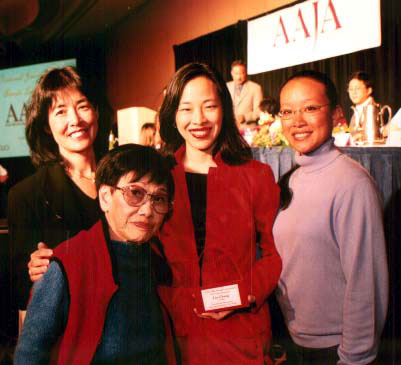
I was thrilled to accept the first National Award for New Media
from the Asian American Journalists Association at their annual
convention for Port of Entry -- my article about my grandmother
and her experience of being detained at the Angel Island Immigration
Station -- in my hometown of San Francisco. Upon my return to New York, on September 10, I got the great news from Katherine Toy, the executive director of the Angel Island Immigration Station Foundation that she would be featuring my Coming to America art exhibit which is based on my Port of Entry article, in the Angel Island Immigration Station Museum. I recall on that day, feeling extremely gratified as an artist, as an actor with my recurring roles on As The World Turns and One Life to Live, as a photographer, I had a retrospective of my work in May in Las Vegas, and as a writer. It had been a busy year and I was looking forward to the rush of the Fall season. Less than 24 hours later, the world stopped and the sky fell in. The first plane hit the World Trade Center when I was still in bed in my New York apartment in the middle of Times Square. I was resting up for the bi-annual frenzy that is Fashion Week in New York.
My first scheduled photo shoot of the day was to be designer Yeohlee's show at Bryant Park at 11AM. My phone rang at 9AM. My sister Marissa was calling me from Daly City, a suburb just south of San Francisco, to tell me a plane had just hit the World Trade Center and to see if my sister Tami and I were okay. I assured her we were fine. I turned on the television. The images I saw were unreal, at first it seemed like an accident, then another plane hit and then the towers came down. My sister Tami, who was working just two blocks away was sent home and we both huddled around the television watching the surreal horror. A plane had crashed into the Pentagon, and another went down in Pennsylvania. The world seemed like it was coming to an end. All the major areas around the country with tall buildings were being evacuated. If Times Square, which is where I live was going to be next, my only thought was to be with my sister. I debated with myself, on whether I should run out and cover the event and get into who knows what or be with my sister. I chose to be with my sister. New York immediately went into lockdown mode. The Frozen Zone of the city was designated as all areas south of 14th Street down to the tip of Manhattan - cars and non-local pedestrian traffic were strictly prohibited. I watched on television as the debris at Ground Zero burned, large crowds gathered in candlelight vigils, and Walls of the Missing and makeshift memorials sprang up all over the city. Thousands of volunteers gathered to help with the recovery efforts at Ground Zero, and many people lined up to give blood. I didn't leave my house for three days. I just couldn't. Part of me felt guilty. As an artist, and a journalist who covers the arts, I celebrate talent, beauty, life and passion. I was still recovering from the unexpected death of my mother in 1999 and death, destruction, pain and suffering were just not in my professional vocabulary. Then a friend, Suzanne Joe Kai, the co-founder of AsianConnections.com, and an award winning broadcast journalist from San Francisco, called from the west coast to check on how I was doing. No pun on words, but she really connected with me. She helped me get over my sense of personal horror and motivated me to document as best I could the devastation that happened to my people in Chinatown. I say "my people" because of my ethnicity, but this horrible event and Suzanne's mission for me indelibly demonstrated that we are all one people.
We had met through
a mutual friend, Ben Fong-Torres, a former senior editor of Rolling
Stone. Also Suzanne and I had been invited to Harvard to serve
on a panel where we addressed the lack of Asian Pacific American
representation in the Media. Just moments earlier, Suzanne had finished
doing an exclusive
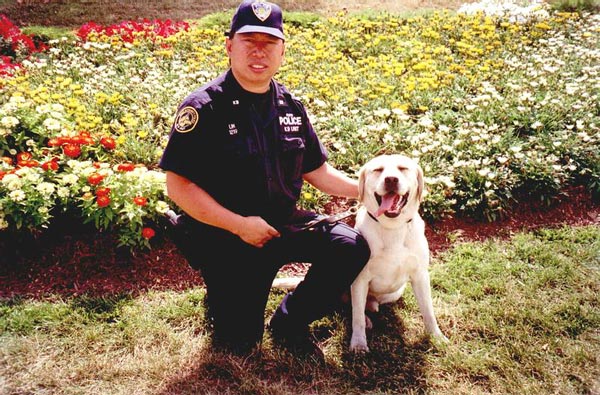
interview by telephone with New York Port Authority Officer
David Lim, one of the last survivors rescued five hours after the
first attack, from an unstable piece of staircase sticking five
stories in the air in the rubble of the Twin Towers collapse. Other AsianConnections team members were sharing their experiences. Suzanne's friends in New York, including writers and reporters at Reuters and CNN were sharing their personal experiences with her. Ben, who is also a columnist at AsianConnections had gotten permission from his friend, novelist Amy Tan to share her personal emails she sent to him about her experience in the City during the attack. Even Suzanne's son Mike, a freshman at Yale and the founder of AsianConnections was sending images and stories from his dorm room on the East coast about the aftermath, but here I was right in New York, a writer and a photographer and I told her I hadn't been out. I told her I felt helpless. I didn't weigh enough to give blood; there were too many volunteers and no survivors to save. I couldn't handle the pain of getting caught up in the huge gatherings of memorials around the city. She encouraged and coached me -- as only a friend could do -- that as a photographer I needed to get back on my feet and get myself in gear. I was in the middle of the most devastating attack on United States soil in modern history and that it was, in a sense, my responsibility as a member of the community to go out and shoot, to face the reality, be careful, but to take action. And of course she reminded me, to photograph how our people, our Asian communities are doing and bring those images back to share with the world.
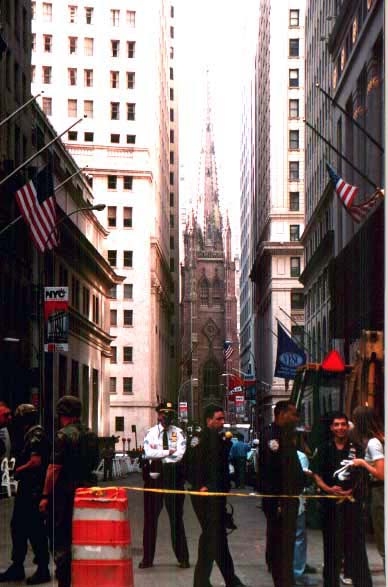
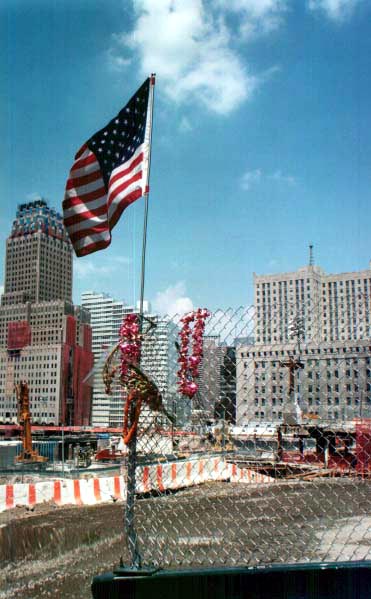
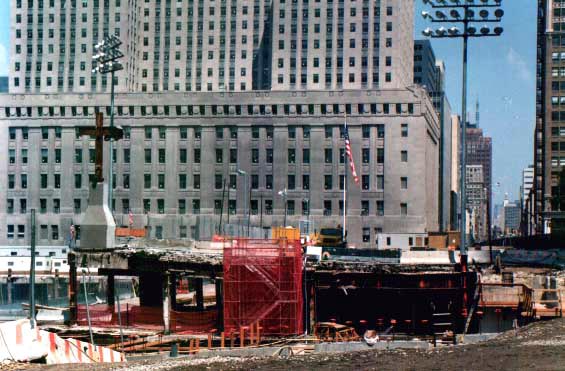
Never in a million years did I think I'd be called on to document a catastrophe of this magnitude. Armed with my Canon �lans, and 3 lenses including my 75-300 lens and my film that was supposed to cover fashion models on runways, instead I made my way down to Ground Zero for the first time to bear witness for myself. The northern boundary for the prohibited zone had been moved south to Canal Street, finally giving me access to Chinatown and possibly Ground Zero just 10 blocks away. As I got closer, it was difficult to breathe. My eyes were burning. I realized,
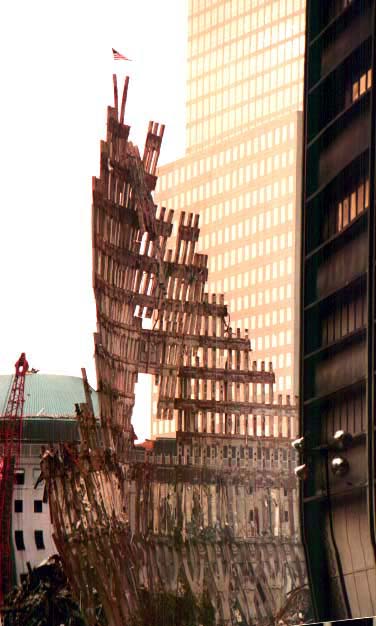
it was just so not real on TV. In person, I saw burnt out shells
of what once was the World Trade Center complex, it was like being
in a war zone. I could feel
the devastation, I could smell the death, and I could sense the
restless souls of those lost in the instant that the Towers came
crashing down. I could see it, I could smell it, it was much worse
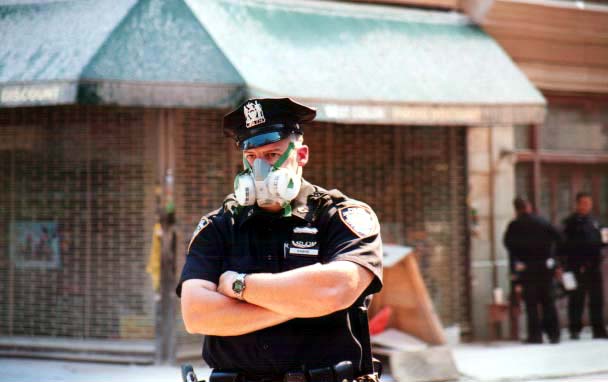
than the images on television. Some people had little white masks
on, police officers had gas masks on and others covered their mouths
with scarves.
There were huge
cracks in some of the sidewalks, as if there had been an earthquake.
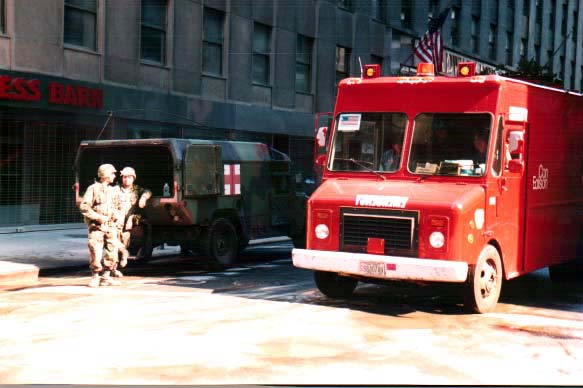
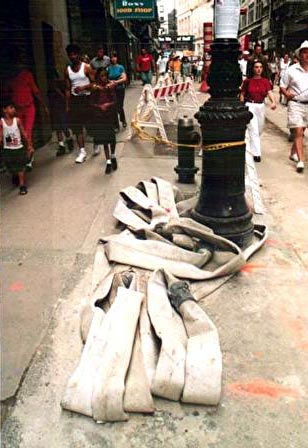
Abandoned fire hoses, fallen street signs, and scattered papers
from the offices of the Twin Towers littered the sidewalks and streets
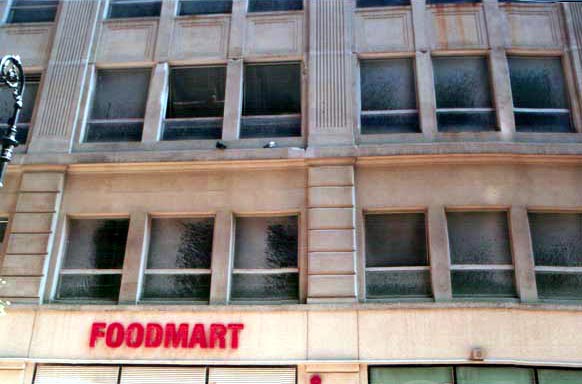
and the dust - from burned computers, burned rugs you could smell
and it tasted like gritty, bitter, burnt rubber. New York State
Troopers and National Guard troops manned barricades and guided
street and pedestrian traffic. I walked to
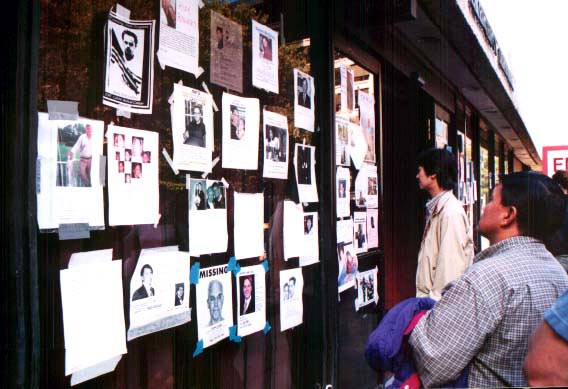
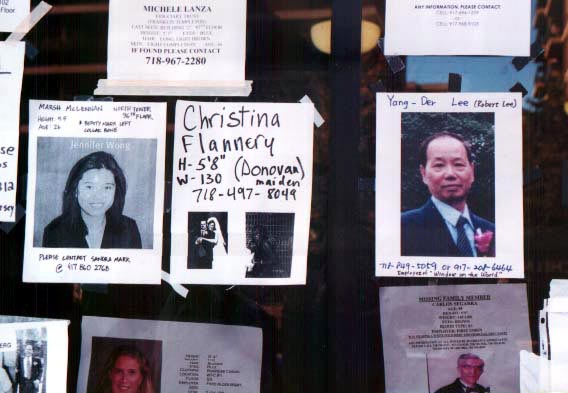
Mt. Sinai Hospital, near Chinatown and found fliers of the missing
covering the windows at the hospital's entrance. I shot by day, and Suzanne and I collaborated by night going over the results of my photos shot that day. She told me that someday those photos of mine would end up in a museum, and encouraged me to do more. On September 21st, I headed to Brooklyn to work at the television studio where for the past 7 years I have played Nurse Chang on the daytime soap opera As The World Turns. It was a surreal experience having just been out in the streets photographing the horrors. Now, as cameras rolled, we were acting in a scene about the death of a major character on the show.
On September
23rd while the world watched on TV as crews were working around
the clock at Ground Zero to find the missing, drawn to what I saw
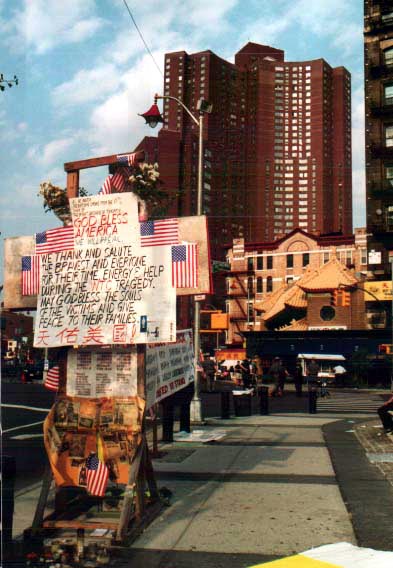
earlier, I made my way back to Chinatown, a community less than
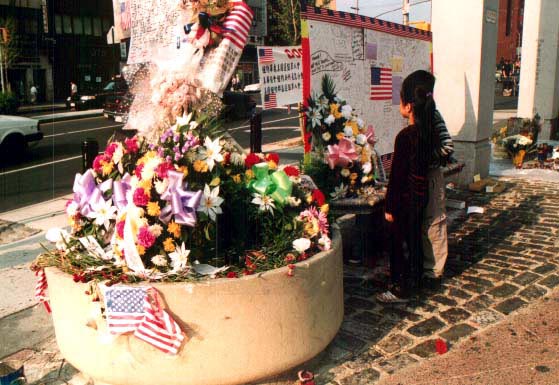
ten blocks from Ground Zero, and photographed makeshift memorials
on Canal Street. I could see
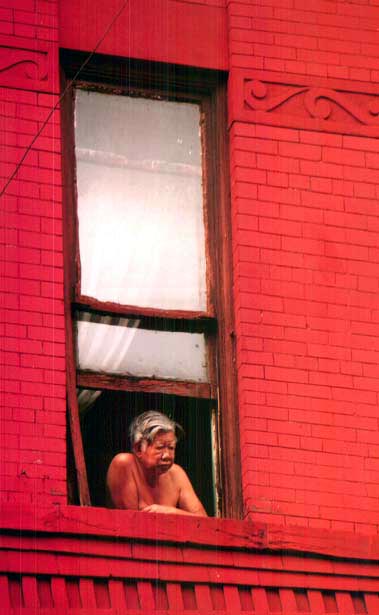
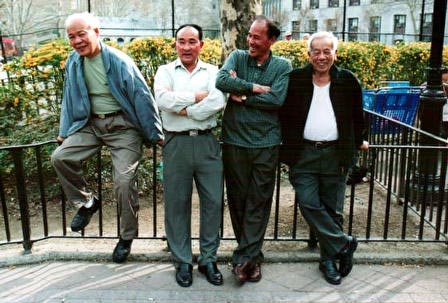
from the faces of the residents and people working in Chinatown
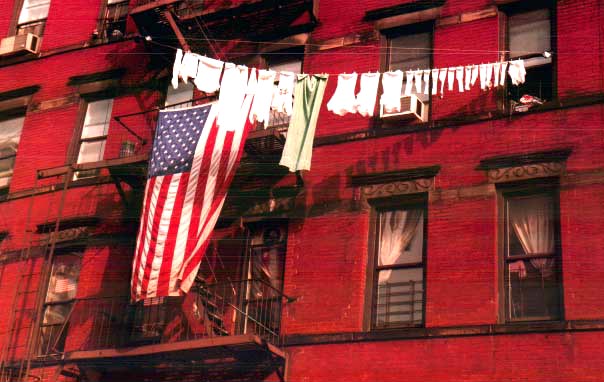
that they were going through their own hell. New York Chinatown
on the weekends is normally bustling with shoppers and people waiting
in line to get into the restaurants. On this particular Sunday afternoon,
it was a warm day and the sky was a brilliant shade of blue. Instead,
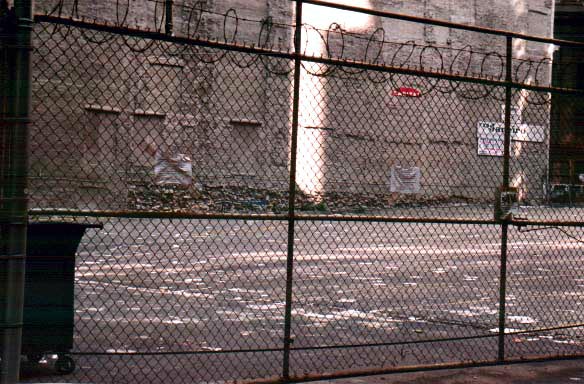
I was overwhelmed by the silence. Because of Chinatown's
close proximity not only to Ground Zero, but to government offices,
streets were barricaded for security reasons and the mood was grim.
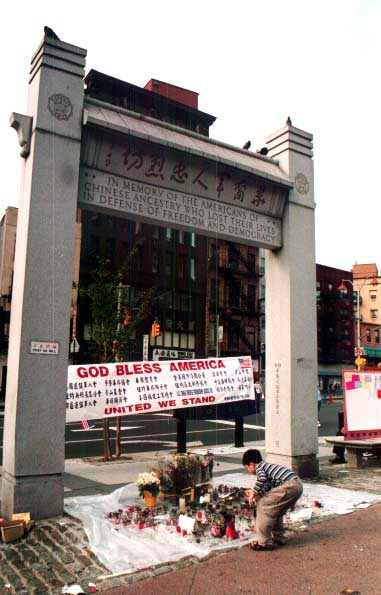
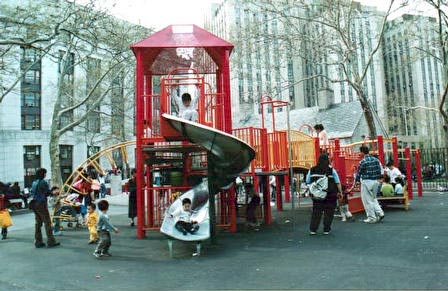
Children lit candles at the makeshift memorials in Chatham Square,
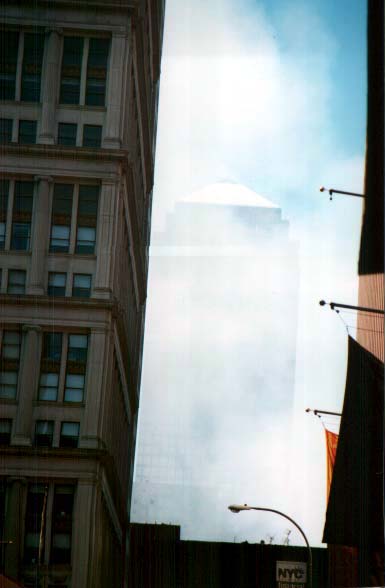
and looking South from this vantage point, a cloud of smoke was
visible in the hole in the sky where the Twin Towers once stood.
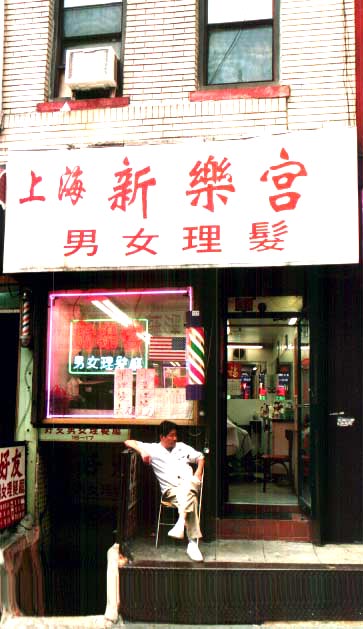
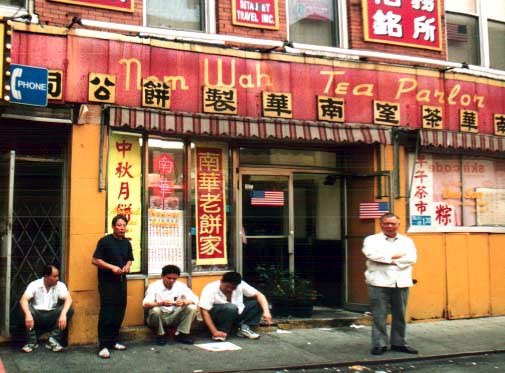
Restaurant workers
and barbers were looking out of their storefront windows waiting
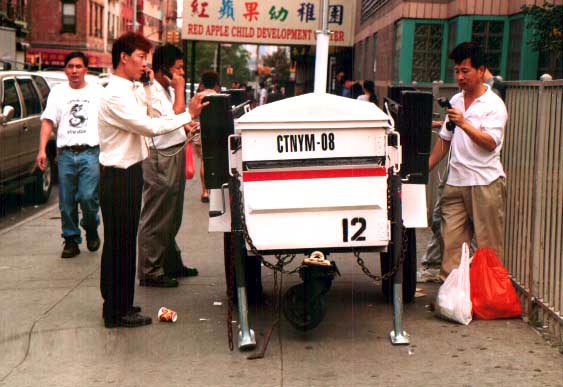
for customers to come. I encountered
frustrated residents using wireless pay phone trailers.
The losses suffered now a year after September 11 by Chinatown's residents, businesses and restaurants are staggering. A month after
the attacks, the New York Times reported that Chinatown had
been "transformed into a near ghost town." It is heartbreaking that many lives were lost on that day. Victims of Asian descent were aboard the planes that crashed and of the 6,000 individuals initially tallied during recovery efforts as missing on the ground, many were Asian American. Thanks to her encouragement, my friend Suzanne was right. In fact, it's been beyond my wildest dreams. My photos originally featured at AsianConnections.com will now be exhibited by not one, but by several museums as part of their fundraisers and exhibitions to help New York's Chinatown community get back on its feet. I remember back to that panel discussion we had at Harvard on the topic of the lack of Asian representation in the media. While others were ranting and raving about the problem, Suzanne and I both felt that the best way was to use your energy to create positive change, and just get out there and do it. Be part of the solution. I'm very grateful that our features will be used to bring attention to help the victims, families and Chinatown community recover from the September 11 tragedy. I'm glad that my images will be part of the healing process.
Related
AsianConnections articles:
|
|||||||||||||||||||||||||||||||
 AsianConnections
Arts and Entertainment Editor Lia Chang is an accomplished stage,
screen and TV actress, fashion and art photographer and writer based
in New York City. To contact Lia, please write lia@asianconnections.com AsianConnections
Arts and Entertainment Editor Lia Chang is an accomplished stage,
screen and TV actress, fashion and art photographer and writer based
in New York City. To contact Lia, please write lia@asianconnections.com |
 |
|||
|
 |
|
|
| | About Us | Disclaimers and Legal Information | Advertise With Us | We welcome your comments. Send e-mail to us at info@asianconnections.com Copyright ©1999-2002 AsianConnections.com |